NOTE: These settlement timelines are automatically managed by OneKhusa based on payment method, the merchant is not required to configure this.
Key Concepts
| Term | Description |
|---|---|
| Transaction Date (T) | The day a payment is successfully processed. |
| Settlement Date (T+n) | The day funds become available for payout. |
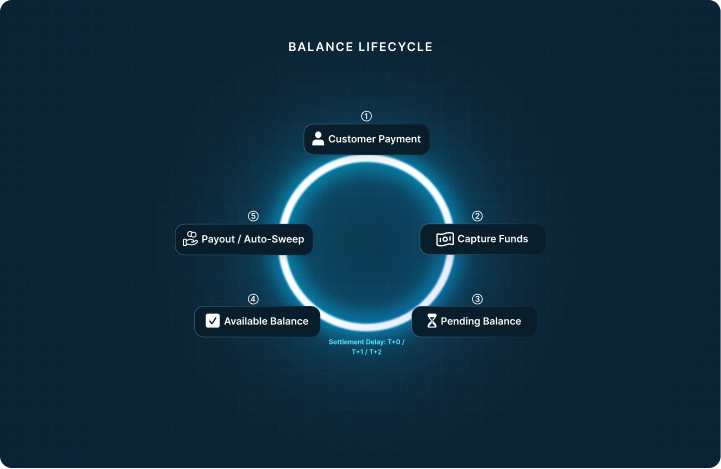
| Pending Balance | Funds captured but not yet settled. |
| Available Balance | Funds eligible for disbursement (payout) or auto-sweep. |
Settlement Cycle Matrix
Understanding the distinction between T+0, T+1, and T+2 settlement models helps developers understand settlement timing, which directly impacts liquidity, reconciliation, and user experience.| Model | Settlement Time | Description | Flow |
|---|---|---|---|
| T+0 | Same Day / Instant | Funds will settle and reflect in the merchant account within 5 minutes. This applies to local mobile money wallet and bank account payments only. | 1. Customer makes payment. 2. Transaction is authorized and captured. 3. Funds remain in Pending Balance for 5 minutes. 4. Funds are released to Available Balance. 5. Merchant can disburse funds or initiate auto-sweep instantly. |
| T+1 | Next Business Day | Funds will settle and reflect in the merchant account within 24 hours. This applies to local card payments and direct MNO push payments. | 1. Payment is processed on Day T. 2. Funds remain in Pending Balance. 3. Funds are released to Available Balance on T+1 for payouts. |
| T+2 | 2 Business Days | Funds will settle and reflect in the merchant account within 2 business days. This applies to international card payments and cross-border payments. | 1. Payment is captured on Day T. 2. Funds are held in Pending Balance for risk checks. 3. Funds are released to Available Balance on T+2 for payouts. |
Balance Lifecycle